The best credit card for a digital nomad is one with no foreign transaction fees, on a network that is widely accepted where you live, that you pay off in full every month, backed up by a second card kept in a different place. Rewards, lounge access and premium perks matter far less than not paying an extra 1 to 3% on every purchase abroad or being unable to pay when a card is lost or frozen.
We do not rank specific cards here because their terms change too often. Since 2025, for example, the annual fee on the Chase Sapphire Reserve has risen from $550 to $795 and on the American Express Platinum from $695 to $895, according to Kiplinger. Instead, this guide shows you what to look for, the costs to avoid and how to set up a payment system that works from anywhere. It is general information, not financial advice.
The costs that matter most abroad
| Cost | What it is | How to avoid it |
|---|---|---|
| Foreign transaction fee | A percentage your card issuer adds to purchases in a foreign currency, typically around 1% to 3%, according to US News | Use a card that charges none |
| Dynamic currency conversion (DCC) | A merchant or ATM offers to charge you in your home currency at its own exchange rate. Published estimates of the extra cost range from a few percent up to about 12% | Always choose the local currency |
| Cash advance | Withdrawing cash with a credit card is usually treated as a loan, with a fee and interest that starts immediately | Use a debit card or a fee-free account for cash |
Here is why the first one matters. A 3% fee on $2,000 of monthly spending abroad is $60 a month, or $720 a year, for nothing. A card that charges no foreign transaction fee removes it entirely, and American Express notes that paying in local currency may be better, especially on a card with no foreign transaction fees.
How to choose a card, step by step
1. No foreign transaction fee
This is the one non-negotiable. Check the card’s terms and conditions, not just the marketing page.
2. A network that works where you live
Visa and Mastercard are accepted almost everywhere. American Express is accepted less widely in many countries, so treat it as a bonus, not your only card.
3. Contactless and mobile wallet support
Most countries now expect contactless or chip payments, and some terminals and machines ask for a PIN. Make sure your card works with a mobile wallet on your phone, which also gives you a backup if your physical card is lost.
4. An annual fee you can justify
Premium travel cards charge hundreds of dollars a year and offset it with credits and perks. Count only the credits you would genuinely use. A credit you have to invent spending to claim is not a saving. If you would not use the perks, a card with a low or no annual fee and no foreign transaction fees is usually the better choice for long-term travel.
5. Simple rewards
Flat cash back or points that are easy to redeem beat complicated category systems for people whose spending changes every month. Points are only worth what you can redeem them for, and rewards never make up for interest, so never carry a balance to earn them.
6. Protections you have actually read
Cards may include trip delay and cancellation cover, lost luggage cover, rental car insurance and phone protection, but the conditions vary. You usually need to pay for the trip with the card, and there are limits and exclusions. Read the card’s benefits guide, and check whether the cover applies to your nationality and country of residence, since benefits on cards issued outside the US can differ. Card cover is usually not a substitute for proper health insurance.
7. An address and access that survive constant travel
Issuers generally need an address where they can mail a replacement card and a phone number or email for verification. Keep these valid, set travel notices where your issuer offers them, and make sure you can receive verification codes abroad. Our guide to savings accounts for digital nomads covers the same address and access issues for bank accounts.
Credit card or debit card?
US News notes that credit cards and cash generally offer more consumer protection than debit cards when used internationally. A debit card draws directly from your bank balance, so a fraudulent charge takes your money first and you must get it back. Use a credit card for purchases, and a debit card or multi-currency account for cash and for spending where credit cards are not accepted. See how to become a digital nomad for a full banking setup.
Pay in the local currency

When a card terminal or ATM asks whether to charge you in your home currency or the local currency, choose the local currency. The home-currency option is dynamic currency conversion. The merchant or machine sets the exchange rate, and it is usually worse than the rate your card network would apply. Check the receipt before you sign, and if the wrong currency was charged, ask for it to be reversed on the spot.
Carry backups, stored separately
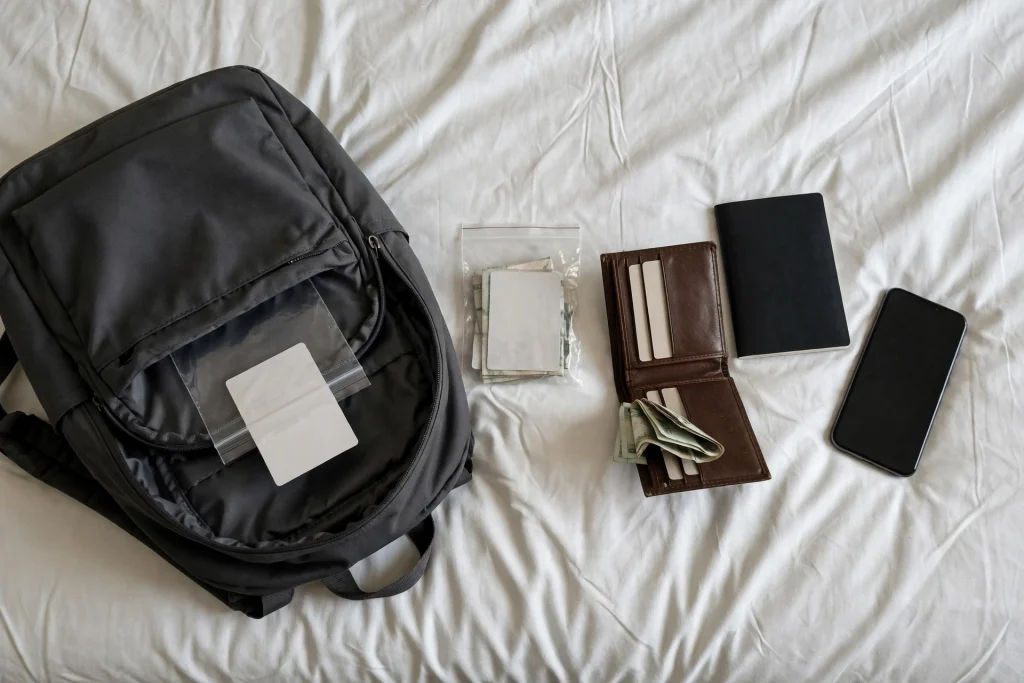
A lost, stolen or frozen card is far more disruptive abroad than at home. A sensible setup is:
- At least two cards from different issuers, ideally one Visa and one Mastercard.
- Stored in different places, for example one in your wallet and one in a zipped pocket in your bag.
- A small amount of cash in a hidden place for emergencies.
- Your issuers’ apps installed, so you can lock a card and request a replacement from your phone, and their contact numbers saved in a form that works from abroad, since toll-free numbers often do not.
Our digital nomad packing list covers the rest of your travel documents.
Rewards and credit history
- Earn on spending you would do anyway. Overspending to chase a sign-up bonus wipes out the reward.
- Pay the full statement balance every month. Interest on cards is usually far higher than any reward you can earn.
- Keep a card from your home country. Credit history generally does not transfer between countries, so an old account in good standing is valuable if you return. Use it occasionally, as issuers may close inactive accounts.
- Budget for it. Fees and exchange-rate costs are part of your monthly budget; see how to travel full-time on a budget.
Frequently asked questions
What is the best credit card for digital nomads?
There is no single best card, because it depends on your country, spending and how much value you place on perks. Start with the essentials: no foreign transaction fees, a widely accepted network, and a fee you can justify. Then compare the current terms of the cards available to you.
Do I need a premium travel card?
No. Premium cards suit people who will use their credits and lounge access. For most nomads, a low-fee card with no foreign transaction fees does the essential job.
Should I pay in the local currency or my home currency?
Local currency. Choosing your home currency triggers dynamic currency conversion, which is usually more expensive than the rate your card network applies.
Can I use a credit card to withdraw cash abroad?
You can, but it is usually treated as a cash advance with a fee and interest from day one. A debit card or a fee-free account is generally cheaper for cash.
Last reviewed: September 2026. Card terms, fees and benefits change often and vary by country and issuer. This article is general information, not financial advice, and we do not recommend specific cards. Check each issuer’s current terms before you apply.