Domicile is your legal home state, the place you intend to return to and treat as your permanent home, and together with state residency rules it decides state income tax, voting, your driver’s license, vehicle registration and where official mail goes for American digital nomads. You cannot create it by renting a mailbox. Tax agencies look at where your real connections are, so the safest plan is to pick a home state deliberately, build genuine ties there, and use a mail forwarding service as a tool for your mail, not as proof of residence. This guide explains how domicile and state residency work, how the popular no-income-tax states differ, what South Dakota and Florida actually require, and how to set up mail properly.
It is general information, not tax or legal advice. State rules are specific and change, and a wrong move can cost you more than the tax you hoped to save, so speak to a cross-border or state tax professional before you change domicile. This guide is for US citizens and residents. For the federal side, see digital nomad taxes.
The short version
- Domicile is about intent and facts, not just an address. States look at where your home, family, accounts, license, voting and time are.
- Leaving a state does not automatically end its tax claim. “Sticky” states such as California, New York and Virginia examine departures closely.
- No-income-tax states still have rules. South Dakota’s full-time traveler route and Florida’s declaration of domicile each come with conditions you must be able to meet honestly.
- A mail forwarding service is not domicile. It receives your mail, needs a notarized USPS form, and may not be accepted as your only address by every bank or office.
- Get advice first. Changing domicile is a legal and tax decision, not an admin task.
Domicile, state residency and mailing address are different things
| Term | What it means | Why it matters to nomads |
|---|---|---|
| Domicile | Your permanent legal home: the place you intend to return to. You can have only one at a time | It usually decides which state can tax your worldwide income |
| Statutory residency | A day-count or abode test that can make you a resident even if you are not domiciled there, often 183 days plus a permanent place of abode | A state can claim you if you keep a home there and spend enough time |
| Mailing address | Where you receive mail, including a forwarding or virtual mailbox address | Useful for logistics, but a mailbox alone does not make a state your home |
| Federal tax residency | The IRS taxes US citizens on worldwide income wherever they live | Federal rules are separate from state rules, and the federal foreign earned income exclusion does not stop a state taxing you |
Do you need to change your state residency at all?
Not necessarily. If you already live in a state without income tax, you can usually keep it as your home base and focus on keeping its ties real. The question matters most if you live in a state that taxes worldwide income and tends to pursue people who leave.
The “sticky state” problem
California, New York, Virginia and a few others are known as sticky states because they audit people who leave and often keep taxing them until they can show they genuinely moved. California, for example, has no simple rule that fewer than 183 days in the state makes you a nonresident. Its Franchise Tax Board looks at where your closest connections are, using the factors in its Publication 1031, and it can keep taxing your worldwide income if you are still domiciled there. New York can treat you as a resident if you keep a permanent home there and spend enough days in the state, and keeping a rental apartment can strengthen that case.
The connections these states look at include your home, family, bank accounts, driver’s license, voter registration, doctors, memberships and where you spend your time. Changing only your mailing address does not move them. If you are leaving a sticky state, talk to a state tax professional before you leave, not after you receive a letter.
Comparing popular no-income-tax states
Alaska, Florida, Nevada, South Dakota, Tennessee, Texas and Wyoming do not tax wages with a state income tax, while Washington and New Hampshire have no tax on wages but treat some investment income differently. Rules change, so confirm each state’s current position. Three states come up most often for nomads:
| State | What stands out | What to check first |
|---|---|---|
| South Dakota | A formal route for full-time travelers who use a mail forwarding address, with a driver’s license, a residency affidavit and a one-night stay receipt | Whether you actually meet the “full-time traveler” definition, and the affidavit you must sign honestly |
| Florida | No state income tax, and a formal Declaration of Domicile you can file with a county clerk | The declaration requires a real place of abode in a Florida county, so a mailbox is not enough |
| Texas | No state income tax and a large range of mail and service providers | Texas’s current residency documents for a license and voter registration, and whether you have a real tie to the state |
South Dakota residency and domicile for full-time travelers
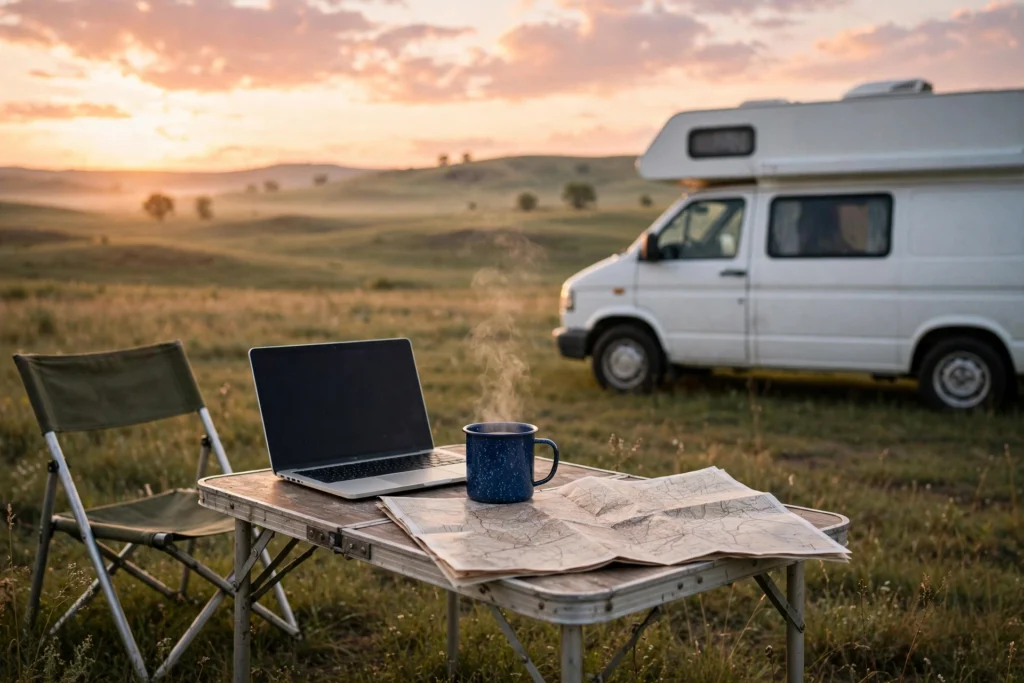
South Dakota is the best-known choice for people without a fixed US home, and its Department of Public Safety describes the process on its page for full-time travelers. Read the conditions closely, because they are narrower than many blog posts suggest.
- Who is eligible. To apply for a South Dakota driver’s license you must have a physical residential address in South Dakota, live full time in an RV or camper, or travel full time for work, with a traveling nurse or truck driver given as examples.
- The mail forwarding route. If you use a mail forwarding service, you complete a residency affidavit with a perjury statement, and your signature must be notarized.
- Proof of stay and mailbox. You provide a receipt from a South Dakota hotel, motel, campground or RV park proving one night’s stay within the past year, and a document showing your name and personal mailbox address.
- Renewals. Renewing or replacing a license again involves a stay receipt, so plan occasional trips or check the current options.
Here is the catch for nomads. The route is written for people who live in an RV or travel full time for work. A digital nomad who lives mostly in other countries may or may not fit that description, and the affidavit is signed under penalty of perjury. Do not sign a statement you cannot honestly make, and ask a professional whether your situation qualifies and how your home state will see it. A South Dakota license also does not, by itself, end another state’s tax claim on you.

Florida domicile and the Declaration of Domicile
Florida has no state income tax on wages, and it offers a formal way to record your domicile. Under section 222.17 of the Florida Statutes, a person who has established a domicile in Florida can file a sworn statement with the clerk of the circuit court in the county where they live, stating that they reside in and maintain a place of abode there that they intend to keep as their permanent home. The form is signed under oath, and county clerks’ forms warn about penalties for perjury.
That wording matters. The declaration assumes you already live in Florida and have a place of abode there, and it records an existing domicile rather than creating one. A forwarding address is not a place of abode. If you plan to use Florida, you need real ties, such as a home or lease, a license, voter registration and financial and medical connections, and not only a mailbox.
Mail forwarding and virtual mailboxes: how to set one up
Whatever state you choose, you need a reliable way to get US mail: tax notices, bank letters, jury summonses, ballots and medical bills. A virtual mailbox or mail forwarding service scans or forwards your mail while you travel. We do not rank providers because prices and terms change quickly, but you can judge any of them with the same checks.
- Understand the form. Any commercial mail receiving agency needs a notarized USPS Form 1583 from you. You show two forms of ID, a photo ID and a document that confirms your home address, and the provider keeps the form on file.
- Check the provider is registered as a commercial mail receiving agency and offers the scanning, forwarding and storage you need.
- Ask what mail they accept. Some do not take packages, certain letters or checks, and fees vary for scanning, forwarding and storage.
- Check where the address will be accepted. Some banks and licensing offices may not accept a commercial mail address as your only address, so ask them before you move your accounts.
- Keep your addresses consistent. Update the IRS, your state, banks, brokers and insurers in a sensible order, and keep records of when each change happened.
- Have a backup. A trusted friend or relative in the US can handle anything that must go to a physical address.
A sensible order of operations
- Find out where you are domiciled today and whether that state is a sticky one.
- Get advice from a tax professional who handles state residency and expats, before you change anything.
- Choose a home state where you can truthfully meet the conditions and where you will keep real ties.
- Set up your mail and your address, with the notarized USPS form and your accounts updated.
- Move your ties in a documented order: license, voter registration, vehicle, accounts, doctors and memberships.
- Cut the old ties and keep proof, such as closed accounts and a license surrendered.
- Vote through the proper channel. The Federal Voting Assistance Program explains how Americans abroad register and request ballots.
- Keep records of days, ties and dates for at least as long as the statute of limitations in your former and new states.
Domicile is one piece of your money setup. For the rest, see credit cards for digital nomads, high-yield savings accounts and investing while traveling full-time, and if you plan to stay abroad for years, how to retire early as a digital nomad.
Frequently asked questions
What is the best state domicile for digital nomads?
There is no single best state. South Dakota, Florida and Texas are the most common choices because they have no state income tax, but the right one depends on where you have genuine ties and whether you can honestly meet that state’s conditions. Get advice before you choose.
How do I change my state residency?
You change state residency by genuinely moving your home and your connections to the new state, then documenting it: a home or qualifying address, driver’s license, voter registration, vehicle registration, accounts and doctors. Your old state may still examine the move, so get advice from a state tax professional before you start.
Can I use a mail forwarding address as my domicile?
A forwarding address can be part of a domicile plan, for example under South Dakota’s full-time traveler route, but a mailbox alone does not make a state your home. States and tax agencies look at where your real connections are, so you need genuine ties and honest statements.
Do I have to visit South Dakota to establish domicile there?
For a driver’s license under the full-time traveler route, South Dakota asks for a receipt proving a one-night stay at a hotel, motel, campground or RV park within the past year, plus a residency affidavit and mailbox proof. Check the Department of Public Safety page for the current rules.
Does the foreign earned income exclusion stop state tax?
No. The federal exclusion applies to federal income tax. A state that still treats you as a resident can tax your income under its own rules, and some states do not follow the federal exclusion.
Is domicile the same as tax residency?
They are related but not identical. Domicile is your permanent legal home, while tax residency can also arise from day counts and a permanent place of abode. A state can tax you under either test, and federal and foreign tax residency are separate again.
Last reviewed: October 2026. State residency, tax, licensing and mail rules change and depend on your circumstances. This article is general information, not tax or legal advice, and it does not recommend specific providers. Confirm details with official state sources and a qualified, licensed professional before you change your domicile.