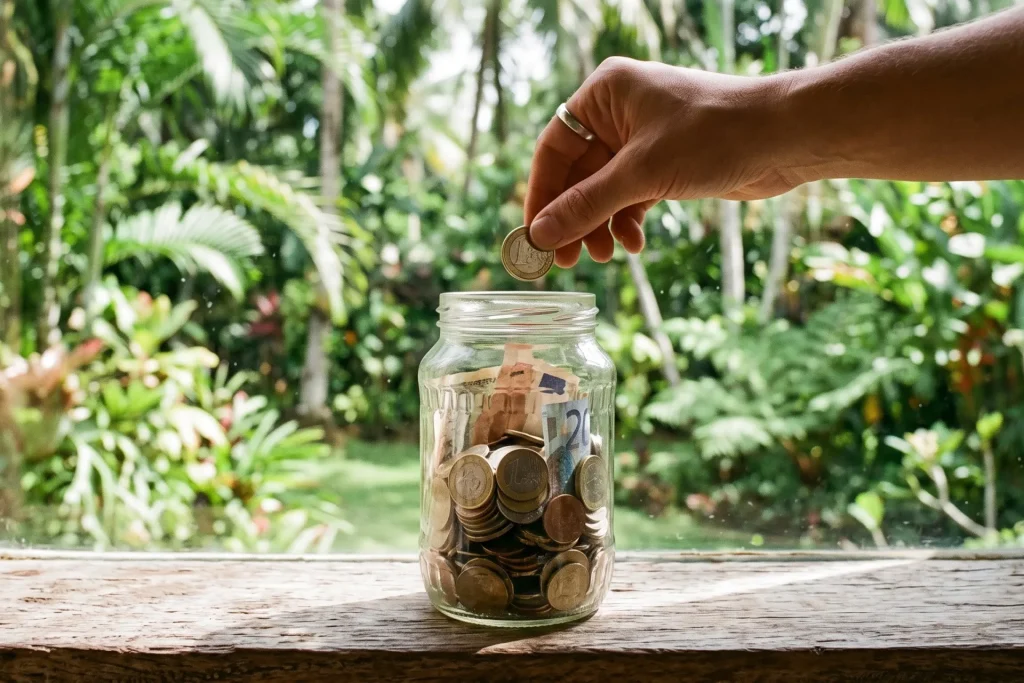
A high-yield savings account is a good home for a nomad’s emergency fund, provided you can open it and keep it working from abroad. Online banks pay far more than big-branch banks: in September 2026 the FDIC national average for savings accounts was around 0.4%, while top online accounts advertised roughly 4% APY. But for nomads the rate is not the main risk. Access is. US banks can restrict or close accounts when they see a foreign address or unusual logins, so the safest setup pairs an insured account with a valid home address on file and a second account as backup.
Because rates change constantly, this guide does not rank specific accounts or quote APYs that will be out of date next month. Instead it shows how to choose, keep and access one, and where to check current rates. It is general information, not financial advice.
What a high-yield savings account pays, and why any quoted rate is a snapshot
Rates on savings accounts are variable and follow the wider interest-rate environment, so they have risen and fallen several times in recent years. US News, citing FDIC data, put the national average savings rate at 0.38% in August 2026, and pointed out that the average is pulled down by large banks that pay close to zero. Online banks compete harder for deposits, which is why their rates are so much higher. Rate trackers such as Forbes Advisor also warn that some advertised rates are temporary promotions, so compare the ongoing APY and not just the headline number.
| Balance | At about 0.4% APY | At about 4% APY |
|---|---|---|
| $10,000 | About $40 a year | About $400 a year |
| $20,000 | About $80 a year | About $800 a year |
These are simple approximations that ignore compounding. The gap is real, but it is worth a few hundred dollars a year on a typical emergency fund, not a reason to take risks with access or safety.
The nomad problem: opening and keeping an account from abroad

Who can open one
Most US online banks require a US address, a Social Security number or tax identification number, and identity verification, so many non-US nomads cannot open a US high-yield account at all. Requirements differ by bank, so check before you start an application. If you are not a US resident, a bank in your own country or a licensed bank in the place you live may be a better fit.
Keeping it once you are abroad
There is no universal rule that a US account freezes after a set number of days abroad. But expat communities regularly report banks flagging or closing accounts after a customer registers a foreign address, or after logins from a new country trigger security checks. Treat it as a risk to manage:
- Keep your contact details up to date, including a phone number that receives verification codes abroad and an email you can access.
- Ask your bank what it requires for the address on file, and whether it accepts customers who live abroad. Some reject P.O. boxes or mail-forwarding addresses.
- Set up travel notices and authentication methods before you leave, not after you are locked out.
- Keep money in at least two places, so a freeze at one bank does not leave you stranded.
- Do not move your whole emergency fund into an account you have not tested from abroad. Send a small transfer first.
For everyday spending, many nomads add a multi-currency account such as Wise or Revolut. Treat those as spending accounts. Check how each provider protects customer balances before you keep large amounts there, as explained below. Our guide on how to become a digital nomad covers the wider banking setup.
Is your money protected?
In the US, the FDIC insures deposits up to at least $250,000 per depositor, per FDIC-insured bank, per ownership category. That covers checking and savings accounts, money market deposit accounts and CDs, but not investments.
Apps are where nomads get caught out. The FDIC’s guidance on banking with apps explains that funds you send to a non-bank company are not FDIC-insured unless and until the company deposits them in an FDIC-insured bank, and that deposit insurance covers the failure of a bank, not of the app company. Before you deposit, find out which bank actually holds your money and read how the provider describes protection for customer funds.
| Where your money is | Deposit protection |
|---|---|
| US FDIC-insured bank | At least $250,000 per depositor, per bank, per ownership category |
| UK-authorized bank, building society or credit union | £120,000 per eligible person, per authorized firm, from 1 December 2025 (FSCS) |
| Bank in an EU country | Standard EU guarantee of €100,000 per depositor, per bank |
| Non-bank money app or multi-currency account | Depends on the provider; check whether balances are held at an insured bank or protected by safeguarding rules |
If your savings exceed the limit at one institution, spread them across more than one bank.
A checklist that goes beyond the rate
| Question | Why it matters for a nomad |
|---|---|
| Can I open it with my citizenship, tax status and address? | Many US accounts need a US address and tax ID |
| Does it work when I log in from abroad? | Foreign logins can trigger extra checks or restrictions |
| Is the rate ongoing or a promotion? | Teaser rates can drop after a few months |
| Who insures the deposit? | A bank is covered by a national scheme; an app may not be |
| How fast can I move money out, and in what currency? | Transfers to another account can take a few business days; emergencies need speed |
| Are there fees or minimums? | Monthly fees can eat the interest on a small balance |
| Is support available in my time zone? | A locked account is worse at 3 a.m. with no one to call |
To compare current rates, start with the FDIC’s published national average as a baseline, then check independent rate trackers, and always confirm the current rate and terms on the bank’s own website before you open an account. Some trackers earn commissions on sign-ups, so use them for comparison, not as the final word.
How much belongs in savings

A common target is three to six months of living costs, more if your income is irregular, held in accounts you can reach quickly. Base the figure on what you spend where you actually live, and, where you can, hold the fund in the currency you spend, so exchange-rate swings do not shrink it. Our guides on whether to quit your job to travel and how to travel full-time on a budget show how to work out your number.
Taxes on interest
Interest is generally taxable income. US banks report interest to US taxpayers, and US citizens are taxed on worldwide income wherever they live. If you open accounts outside the US, additional reporting, such as the FBAR for foreign accounts above $10,000 in total, may apply. Other countries tax interest according to your residence. Because rules depend on your citizenship and where you are tax resident, talk to an accountant who works with expats before you move large sums.
Other places to keep cash
- Certificates of deposit (CDs). Lock in a fixed rate for a set period, but early withdrawal usually costs a penalty, so they suit money you will not need soon.
- Money market accounts and funds. A money market deposit account at a bank is insured; a money market fund is an investment and is not.
- Government bills and bonds. Low risk, but they involve a brokerage account and different rules for non-residents.
Money you will not need for years belongs in a different category from an emergency fund. See our guide to investing while traveling full-time, and for the cards you carry, credit cards for travelers and digital nomads.
Frequently asked questions
Can I keep a US high-yield savings account while living abroad?
Often yes, but banks differ. Some restrict or close accounts when they see a foreign address or unusual logins, so ask your bank about its policy, keep your contact details current, and keep a backup account elsewhere.
Are Wise and Revolut balances FDIC insured?
Not automatically. The FDIC says funds sent to a non-bank company are not FDIC-insured unless they are deposited at an insured bank, and even then the insurance protects against the bank’s failure, not the company’s. Check each provider’s terms for how customer money is held and protected.
What is a good APY for a savings account?
Compare against the current national average and the top online accounts rather than a fixed number. In September 2026 the national average was around 0.4% while the top online accounts advertised roughly 4%, but both move with interest rates.
How much should I keep in savings as a digital nomad?
A common guideline is three to six months of living costs, or more if your income is irregular, in accounts you can reach quickly from wherever you are.
Last reviewed: September 2026. Interest rates, deposit protection limits, bank policies and tax rules change and depend on your citizenship and residence. This article is general information, not financial, tax or legal advice, and we do not recommend specific accounts. Check current terms with each provider and consider speaking to a qualified adviser.