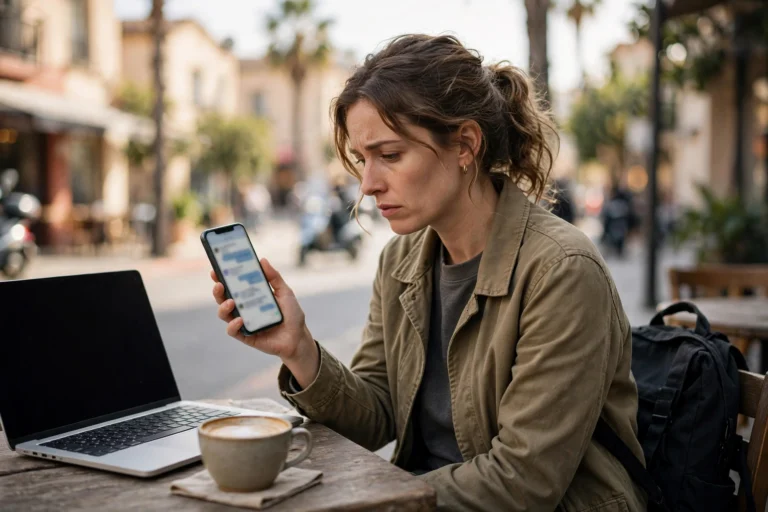
Digital nomad loneliness is common, it usually has identifiable causes, and the habits that help are specific enough to plan. Constant moves, short stays and work that happens alone on a laptop make it harder to build the repeated contact that friendships need. This guide explains what loneliness is, what the research does and does not say about nomads, how it changes over time and what to do about it, including when to ask for professional help.
It is general information, not mental health care or medical advice. If you are struggling, please speak to a doctor or a qualified professional. If you are in immediate danger, contact your local emergency services.
The short version
- Loneliness is a feeling, isolation is a circumstance. You can be surrounded by people and lonely, or alone and fine.
- It is widespread. The World Health Organization (WHO) reports that 1 in 6 people worldwide are affected by loneliness.
- Nomad life adds specific pressures: short stays, repeated resets of routine, solo work and constant comparison online.
- Repetition beats volume. One activity you attend every week usually does more than many one-off events.
- Know the point to ask for help. Persistent low mood, loss of interest or hopelessness deserve a conversation with a professional.
Loneliness and isolation are different things
WHO separates two ideas that people often mix up. Loneliness is the painful feeling that arises from a gap between the social connections you want and the ones you have. Social isolation is the objective lack of sufficient social connections. The two can overlap, but they do not always travel together.
| Loneliness | Social isolation | |
|---|---|---|
| What it is | A feeling that your connections fall short of what you want | A measurable shortage of contact with other people |
| How to tell | You feel unseen or disconnected, even in a busy coworking space | You go days without a real conversation |
| What helps first | Deeper contact with a few people, including people from home | More regular contact of any kind, then deeper contact |
This matters for nomads because the usual advice, “go to more events”, only treats isolation. If you already meet people daily and still feel lonely, the missing piece is usually depth and continuity, not another meetup.
How common is it, and what does the evidence say?
In a report released in June 2025, the WHO Commission on Social Connection found that 1 in 6 people worldwide is affected by loneliness, and linked it to more than 871,000 deaths a year. Rates differ by age and income: the WHO reports that 17 to 21 percent of people aged 13 to 29 reported feeling lonely, and about 24 percent of people in low-income countries compared with about 11 percent in high-income countries.
A US study by the Centers for Disease Control and Prevention (CDC) used 2022 survey data from 218,915 adults in 26 states. It found that 32.1 percent reported loneliness. Adults who reported loneliness were more likely to report stress, frequent mental distress and a history of depression, even after adjusting for age, income, marital status and other factors. The authors note that this shows association, not cause, and the sample is US adults in general, not remote workers.
For nomads specifically, the research is thin. One peer-reviewed study, presented at the 2023 Hawaii International Conference on System Sciences, interviewed 15 digital nomads about loneliness and fear of missing out (FOMO). The authors describe how nomads use social media and communities to cope, and how intensive social media use can produce FOMO that adds to the strain. Fifteen interviews cannot tell us how common loneliness is among nomads. It shows that the experience is real and worth taking seriously, and little more.
Why life on the move makes it harder
The following patterns come up repeatedly in nomad accounts. They are observations, not measured causes.
- Short stays discourage deep friendships. It is hard to invest in someone who leaves in three weeks, and hard to be invested in when you are the one leaving.
- Routine keeps resetting. The weekly coffee, the regular gym class and the café where staff know you take months to build. Moving wipes them out.
- Work happens alone. A laptop job removes the accidental contact of an office.
- Time zones separate you from home. Calls with friends and family need planning, and they slip. Our guide to time zone overlap shows how to choose a base that leaves room for both work and calls home.
- Comparison. Following other people’s highlights can make a quiet evening feel like missing out, which is the FOMO the 2023 study describes.
Loneliness by stage
This table is our own framework, built from common nomad experiences. It is a judgment, not research, and people vary a great deal.
| Stage | What tends to happen | What helps first |
|---|---|---|
| First month | Novelty covers it up, then the first quiet week lands hard | One recurring weekly activity, started in the first ten days |
| Months two to six | Friends from short stays move on, and routine matters more than novelty | Staying long enough to repeat things, and a regular place to work |
| Year two and beyond | Friendships can feel shallow, and ties to home may have faded | A scheduled rhythm of calls and visits with people from home, and a longer base |
What helps, from least to most effort
Low effort
- Schedule contact with people you already know. A standing weekly call beats an occasional long one. Put it in your calendar like a work meeting.
- Become a regular somewhere. The same café, bakery or climbing wall, at roughly the same time each week. Familiar faces turn into conversations.
- Move your work into shared spaces some days. Even without talking, working near other people reduces the silence of a rented room.
Medium effort
- Join something with a repeating schedule. A language class, sports club, volunteer shift or coworking membership gives you the same people week after week.
- Use communities to find an anchor, not a crowd. Online groups and event pages are good for finding one or two regular activities. Do not measure success by how many events you attend.
- Stay at least a month. Our guide to making friends while traveling solo covers where to meet people and why a month in one place changes how connections form.

Higher effort
- Choose a base, not a route. Slow travel gives relationships time to form. See slow travel for digital nomads for how long to stay in each place.
- Consider coliving or shared housing for the first months in a new place. It gives you daily contact without needing to organise it. Check the contract terms and cancellation rules before you commit.
- Decide what you want your life to look like. If loneliness keeps returning wherever you go, it may be telling you something about the lifestyle. Our guide to digital nomad pros and cons gives an honest look at the trade-offs.
If you are an introvert
Large mixers can drain you and leave you lonelier. Fewer, smaller and repeated meetings usually work better: a weekly dinner with the same four people, a regular climbing partner, a language exchange pair. Depth builds from repetition, and you do not need a large circle to feel connected.
Meeting people safely
- Meet in public places for the first few times.
- Tell someone you trust where you are going and when you expect to be back.
- Be cautious with invitations from people you have only met online, especially to private homes or remote places.
- Trust discomfort. You do not owe anyone an explanation for leaving.
Our guide to digital nomad scams covers fraud to watch for when you are new somewhere.
When it is more than loneliness
Loneliness is a normal human response, and it often eases as routines and friendships form. It becomes a reason to talk to a professional when it lasts for weeks and starts to affect how you live. Signs worth taking seriously include a low mood that does not lift, losing interest in things you usually enjoy, changes in sleep or appetite, difficulty working, feeling hopeless or having thoughts of harming yourself. This list is not a diagnosis, and you do not need to meet a threshold to ask for support.
- In the United States: the 988 Suicide and Crisis Lifeline offers free, confidential support by call or text at 988, or by chat at 988lifeline.org, 24 hours a day.
- In the United Kingdom and Ireland: Samaritans offers a free helpline on 116 123, open 24 hours a day.
- Elsewhere: emergency numbers and crisis lines differ by country. Search for your current country’s crisis line on your health ministry’s official website, and save the number before you need it.
- Online therapy: licensing rules affect which professionals can treat you across borders. Our burnout guide explains how to find support abroad, and our health insurance guide shows what to check about mental health cover.
If you are not sure whether what you feel is loneliness or burnout, the burnout guide lists the warning signs. The two often overlap, and work-life balance is one place where both improve.
A 30-day plan
| Week | One action |
|---|---|
| 1 | Book a standing weekly call with someone from home, and choose one café or workspace as your regular spot |
| 2 | Find one activity with a repeating schedule and attend it twice |
| 3 | Invite one person you have met for a second meeting, such as coffee or a walk |
| 4 | Review: what felt good, what drained you, and whether this place is worth a longer stay |
Adjust the plan to your energy. The aim is one repeated thing, not a full social calendar.
Frequently asked questions
Do digital nomads get lonely?
Many do. No large study measures how common it is among nomads, but a 2023 peer-reviewed interview study of 15 nomads found loneliness and fear of missing out to be real concerns. Loneliness is also common in the general population, with the WHO estimating that 1 in 6 people worldwide are affected.
Is loneliness the same as being alone?
No. Being alone is a circumstance, and plenty of people enjoy it. Loneliness is the painful feeling that your connections fall short of what you want. You can feel lonely in a crowd and content on your own.
Does loneliness get better the longer you travel?
It varies. Some people adjust as they build routines and a network, while others find that constant moving keeps resetting progress. Staying longer in each place gives friendships more time to form, which is why slow travel is often suggested.
How do I make friends if I am an introvert?
Aim for fewer, smaller and repeated meetings rather than large events. A weekly class, a language exchange or a regular dinner with the same few people builds depth without draining your energy.
Is it burnout or loneliness?
They overlap, and one can feed the other. Burnout tends to show up as exhaustion, cynicism about work and reduced effectiveness, while loneliness is about disconnection. If you are unsure, read our burnout guide and consider speaking to a professional.
When should I talk to a professional?
When low mood, loss of interest, sleep or appetite changes, or hopelessness last for weeks or affect your daily life, or at any time you have thoughts of harming yourself. You do not need to wait for a crisis, and many people find an early conversation helps.
Sources
- World Health Organization, “Social connection linked to improved health and reduced risk of early death”, news release, 30 June 2025. who.int. Accessed October 2026.
- Bruss KV, Seth P, Zhao G. “Loneliness, Lack of Social and Emotional Support, and Mental Health Issues — United States, 2022.” CDC Morbidity and Mortality Weekly Report 2024;73(24):539–545. doi:10.15585/mmwr.mm7324a1. Accessed October 2026.
- Miguel C, Lutz C, Majetić F, Perez-Vega R, Sanchez-Razo M. “It’s not All Shiny and Glamorous: Loneliness and Fear of Missing Out among Digital Nomads.” Proceedings of the 56th Hawaii International Conference on System Sciences, 2023. doi:10.24251/HICSS.2023.564. Accessed October 2026.
- 988 Suicide & Crisis Lifeline. 988lifeline.org. Accessed October 2026.
- Samaritans, “Contact a Samaritan”. samaritans.org. Accessed October 2026.
Last reviewed: October 2026. This article is general information, not medical or mental health advice. Helplines and research findings change, so check the official sources linked above before you rely on them, and speak to a qualified professional if you are struggling.