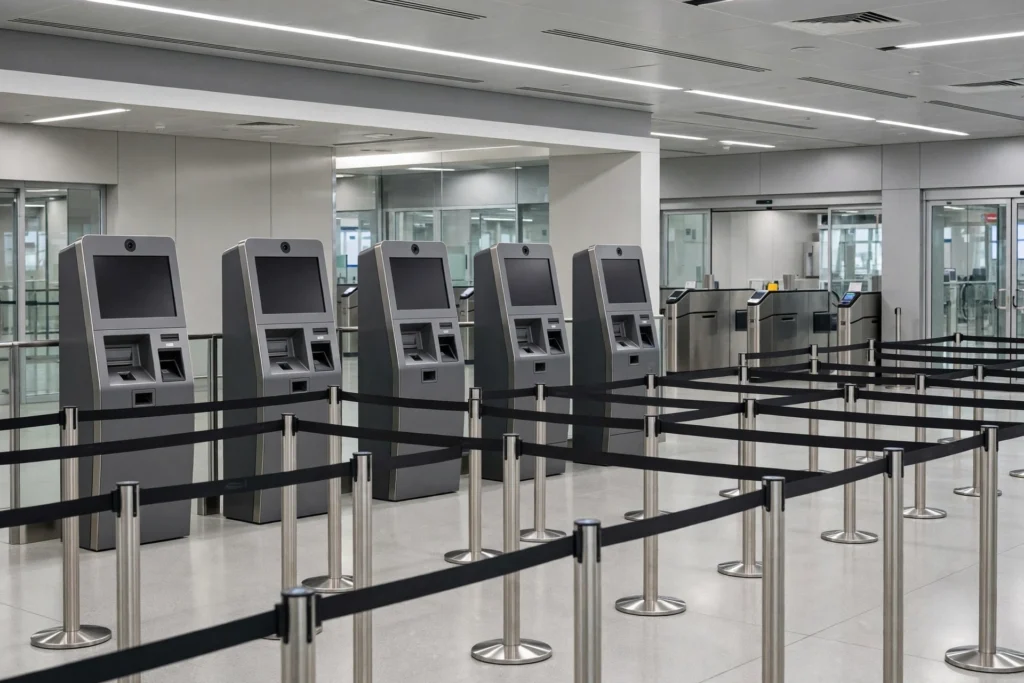
The Entry/Exit System (EES) is the European Union’s automated border system for non-EU visitors on short stays. It replaces passport stamping with a digital record of each entry and exit, and the European Commission says it became fully operational on 10 April 2026. The 90 days in any 180 rule that governs short Schengen stays is the same as before. What changed is how it is checked: the system automatically detects people who stay too long, so an informal approach to counting days is now risky. This guide explains what EES records, how the rolling count works with a worked example, what it means for digital nomads and what we could not confirm.
This is general information about entry rules, not immigration or legal advice. Rules differ by nationality, visa type and country, and they change. Check the official pages linked below, and your own government’s travel advice, before you travel.
The short version
- EES registers non-EU nationals on short stays at the external borders of 29 European countries. The European Commission lists name, travel document data, fingerprints, facial images, dates and places of entry and exit, and refusals of entry.
- The stay limit is a maximum of 90 days within any 180-day period. The Commission’s calculator counts back 180 days from each day of your stay.
- The Commission says EES automatically detects overstayers. Do not rely on passport stamps or memory. Keep your own day count.
- The Commission’s calculator page says holders of EU residence permits and long-stay (D-type) visas are not subject to the 90/180 rule. How short trips to other Schengen countries are treated for those holders is unclear in our sources.
- ETIAS, the separate pre-travel authorisation, has no confirmed start date that we could verify. Treat any date or fee you read as unconfirmed.
What EES is
The European Commission describes EES as an automated IT system for registering non-EU nationals travelling for a short stay. It records entries and exits at the external borders of 29 European countries. Its page gives 12 October 2025 as the start of a progressive launch and 10 April 2026 as the date it became fully operational. It says the system replaces passport stamping and automatically detects overstayers, meaning travellers who have exceeded their maximum authorised stay.
| Item | What the official page says |
|---|---|
| Who it covers | Non-EU nationals travelling for a short stay |
| Where | External borders of 29 European countries |
| What it records | Name, travel document data, fingerprints, facial images, date and place of entry and exit, refusals of entry |
| Started | Progressive start 12 October 2025 |
| Fully operational | 10 April 2026 |
| Effect on stamps | Replaces passport stamping |
| Overstays | Detected automatically |
The Commission page we read does not say how long data is kept and does not list exemptions, so we do not state either. The 29 countries are the Schengen Area as described on the Commission’s calculator page, which also notes that Cyprus and Ireland are not part of it.
What registration looks like for travellers
We read the UK government’s Travel Aware page, which is written for UK passport holders. It says there is no action to take before you arrive and no cost for EES registration. It says short-stay passport holders entering the Schengen Area may need to register biometric details such as fingerprints, a photo or both, and that the digital record is valid for three years. For journeys from Dover, Folkestone and St Pancras, it says information is taken before leaving the UK. It also says to allow extra time because queues may be longer.
The same page says British nationals living in the EU with Withdrawal Agreement rights are exempt if they can show their residence document. We did not read equivalent pages for the United States, Canada, Australia or New Zealand, so check your own government’s travel advice for details that apply to you. Registration steps and exemptions can differ by nationality and border.
How the 90/180 count works
The Commission’s short-stay calculator page states that you are usually allowed to stay for a maximum of 90 days within any 180-day period. To check a stay, you count back 180 days from each day of your stay. The calculator has two modes. A check mode tests past and ongoing stays and gives the last day that is still allowed. A planning mode calculates the maximum stay for a future entry date. The Commission says not to use it if the stay on your visa sticker is shorter than 90 days.
Because the window moves, leaving the Schengen Area does not reset the counter. Days drop out of the window one at a time as they pass 180 days ago. The example below is our own arithmetic, using the counting method on the Commission’s page. It is an illustration with day numbers, not a prediction for any real trip.
| Day numbers | Where you are | Days counted in the last 180 |
|---|---|---|
| 1 to 45 | Inside Schengen (first stay) | 45 by day 45 |
| 46 to 75 | Outside | Still 45 |
| 76 to 120 | Inside Schengen (second stay) | 90 on day 120. This is the limit |
| If you stayed on to day 121 | Inside | 91. This is an overstay |
| If you left on day 120 and return on day 181 | Re-enter | The window is now days 2 to 181, so day 1 has dropped out. Days 2 to 45 (44 days) plus days 76 to 120 (45 days) make 89, and day 181 itself brings the total to 90 |
| Staying on from day 181 | Inside | Each new day adds one day and drops one old day, so the total stays at 90 through day 224. On day 225 the first stay has dropped out completely and the total is still 90 (45 days from the second stay plus 45 new days). Day 226 would make 91 |
The pattern is that each new day inside needs one old day to fall out of the window. In the example, the traveller who left on day 120 can come back on day 181 and stay for 45 days, not another 90. Someone who spends the full 90 days in one block regains the full allowance only gradually, as those days age out. This is why a long stay followed by a quick return often fails.
What EES changes in practice
- Your record is digital. A stamp can be missing or unreadable. A system record cannot be, and the Commission says it replaces stamping.
- Overstays are flagged automatically. The Commission says the system detects travellers who exceed their authorised stay. We could not find an official statement of the penalties, which the UK page says each member state enforces.
- The first crossing may take longer. The UK page says to expect possible longer queues and to allow extra time. Exits are recorded too, so allow time at departure as well.
- Entry rules themselves are the same. Visa requirements and the 90/180 limit did not change. The check became more reliable.
Secondary guides report long queues in the first weeks of full operation and counts of people refused entry. We could not match those figures to an official source, so we do not repeat them.
What it means for digital nomads
Keep your own day count
A simple log with the date of each entry and exit lets you check yourself before you book. Keep boarding passes or booking confirmations as back-up, because they show what you did if your own record and the system disagree. Use the Commission’s calculator in planning mode before you book a return trip. It is a helping tool, so treat the result as a check on your own count.
Plan with a buffer
Leaving on your last allowed day leaves no room for a delayed flight or a missed connection. In our judgment, planning to leave a few days early costs little and protects against a mistake that would be recorded automatically.
Residence permits and long-stay visas
The Commission’s calculator page says holders of EU residence permits and long-stay (D-type) visas are not subject to the 90/180 rule and should not enter their stays in the calculator. That is why several national digital nomad programmes appeal to people who want more than 90 days. Our guides to how digital nomad visas work and choosing a base compare the routes, and our city guides for Lisbon and Madeira describe one of them.
One point is unsettled in our sources. Guides disagree on whether a short trip to another Schengen country while you hold a long-stay visa or permit counts against a separate 90/180 allowance. The Commission page we read does not address it. Ask the immigration authority of the country that issued your visa, and do not rely on a blog.
Days in Europe can matter for tax too
Staying within the visa limit says nothing about where you owe tax. Day counts and tax residency use different rules. Our tax residency guide explains the difference, and our year-end checklist includes a day-count review.
What about ETIAS?
ETIAS is a separate pre-travel authorisation that the EU has planned for visa-exempt visitors. We could not read the official ETIAS page: our tool returned no text for it. Secondary sources conflict. Older pages say it will launch in the last quarter of 2026. Newer reports say the official site removed that target in July 2026 and that a full start around April 2027 is possible. Fees quoted differ between sources. We could not verify any of this from an official page, so treat every date and fee as unconfirmed.
Reports also say applications are not yet open, and that scam sites imitate ETIAS. Only use the EU’s official travel site (travel-europe.europa.eu) and check it again before you plan a trip for 2027.
A checklist before your next Schengen trip
- Write down every Schengen entry and exit date for the last 180 days.
- Run the Commission’s calculator in planning mode for your planned entry date.
- Check your own government’s travel advice page for EES and your nationality.
- Allow extra time at the border on the way in and the way out.
- Keep booking confirmations and boarding passes for each crossing.
- If you hold a long-stay visa or a residence permit, carry the document and confirm the rules for trips to other Schengen countries with the issuing authority.
- Add a buffer of a few days before your last allowed day.

For a wider plan on how long to stay where, our guide to slow travel covers the 90/180 rule and routes, and our moving abroad checklist covers visas and documents.
Frequently asked questions
Does EES change the 90/180 rule?
No. The limit is the same maximum of 90 days within any 180-day period. What changed is the way it is recorded and checked: the Commission says EES replaces passport stamping and automatically detects overstayers.
Do I need to register before I travel?
For UK passport holders, the UK government says no action is needed in advance and registration is free. Your own government may give different details, so check its travel advice page for your nationality.
How long does an EES registration last?
The UK government’s Travel Aware page says the digital record is valid for three years. We did not find an official statement of how long entries are stored.
Does a digital nomad visa stop days counting toward 90/180?
The Commission’s calculator page says holders of long-stay (D-type) visas and EU residence permits are not subject to the rule and should not enter those stays. What happens on short trips to other Schengen countries is not clear in our sources, so ask the authority that issued your visa.
When does ETIAS start?
We could not confirm a date from an official page. Secondary sources conflict, with some pointing to late 2026 and newer reports to 2027. Check the EU’s official travel site before you plan around it.
Sources
- European Commission, Migration and Home Affairs, “Entry/Exit System (EES)”, page dated 10 April 2026. home-affairs.ec.europa.eu. Accessed October 2026.
- European Commission, Migration and Home Affairs, “Short-stay calculator”, last updated 27 October 2025. home-affairs.ec.europa.eu. Accessed October 2026.
- UK Government, Travel Aware, “European Entry/Exit System”, no date shown. travelaware.campaign.gov.uk. Accessed October 2026.
- Secondary guides on EES and ETIAS (Nomada, Beancount.io, Visa-Calculator.com) were read as leads. They carry no official citations and are not used as evidence. Accessed October 2026.
Last reviewed: October 2026. This article is general information, not immigration or legal advice. EES procedures, ETIAS timing and national rules change, so check the official pages above before you travel.