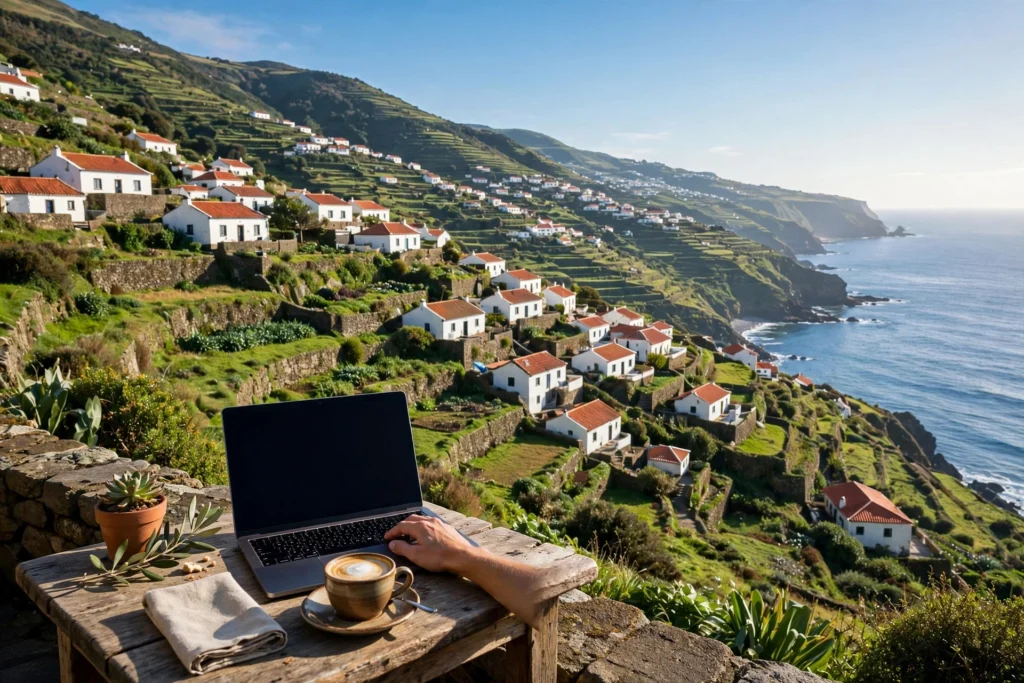
Madeira is a Portuguese island in the Atlantic with a mild climate, hiking, a government-backed programme for remote workers and the legal framework of Portugal and the Schengen area. It also asks more of you than a big city: an island is a small place, flights and community depend on the season, and the weather and terrain shape daily life. This guide covers visas, costs, healthcare, isolation and community and safety, with every figure dated and sourced.
It is general information, not legal, tax, medical or safety advice. Costs come from a small crowdsourced sample and move with prices, and visa rules change, so confirm details with official sources before you go.
Madeira at a glance
| What to know | |
|---|---|
| Monthly cost for one person in Funchal (our sum of Numbeo figures, October 2026) | About €1,760 with a one-bedroom outside the centre, or about €2,000 with one in the centre. The sample is small, so treat it with care |
| Short stays | Visa-free travel for up to 90 days in any 180-day period for eligible nationalities, under the Schengen rules |
| Longer stays for remote workers | Portugal’s D8 route. The income test is four times the monthly minimum wage, averaged over three months |
| Programme for remote workers | The Digital Nomads Madeira community, with free registration and a free working space in Ponta do Sol |
| Wildfire risk | Higher from April to October across Portugal |
Visas and entry
Short stays. Under the Schengen rules, eligible visitors can stay up to 90 days in any 180-day period, and days spent in other Schengen countries count toward the 90. Passport validity and entry-system rules apply, and the UK government notes that biometric registration is now required on short stays. Our slow travel guide explains how to plan around the limit.
The D8 route. The Portuguese national visa portal lists a route for remote work, described as the exercise of a professional activity done remotely by digital nomads. It asks for proof of average monthly income over the last three months of at least four times the monthly minimum guaranteed remuneration. For subordinate work you need a work contract or an employer declaration, and for independent work you need a company contract, a service provision contract or a document showing services provided to one or more entities. You also need proof of fiscal residence, and the consular post may ask for more documents.
The portal gives the 2026 minimum monthly wage as €920 (Regulatory Decree 139/2025). Four times €920 is €3,680 a month. The portal does not print that total, so it is our arithmetic. The figure changes when the minimum wage changes, so confirm the current number with your consulate. Our visas guide explains how these applications work, and Lisbon covers life on the mainland.
Tax is separate from your visa. Time spent in Portugal can create tax duties, and US citizens keep US filing duties. Portuguese tax regimes for new residents have changed in recent years, so check the Portuguese Tax Authority or a professional. Read digital nomad taxes for the general picture.
The Digital Nomads Madeira programme
The official Digital Nomads Madeira site, run with Startup Madeira, says the community has been active since February 2021. Registration is listed as free. The site lists a Slack and WhatsApp community, a free working space in Ponta do Sol, a list of private working spaces, exclusive events, a list of local accommodation and a connection to the local community. It names Ponta do Sol as the nomad village, and Funchal, Machico and Santa Cruz as other official locations.
The site does not state eligibility rules, opening hours or capacity for the free workspace, and it carries no update date, so check its current terms at digitalnomads.startupmadeira.eu before you plan around it. The programme is a community and a workspace. It is not a visa.
What it costs
Numbeo is a crowdsourced database, so treat its numbers as a guide, not a quote. The Funchal page was last updated on 2 October 2026 but drew on only 26 contributors and 152 entries over the past year, which is a small sample. Figures are in euros.
| Item | Numbeo estimate |
|---|---|
| One-bedroom apartment, city centre | €1,336 a month (range €1,100 to 1,500) |
| One-bedroom apartment, outside the centre | €1,098 a month (range €850 to 1,200) |
| One person’s monthly costs, excluding rent | €664 |
| Broadband internet, 60 Mbps or faster | €44 a month (range €22 to 59) |
| Basic utilities, 85 square metre apartment | €109 a month (range €80 to 160) |
| Monthly public transport pass | €30 (range €30 to 40) |
| Gym membership | €37 a month (range €28 to 50) |
| Meal at an inexpensive restaurant | €13.50 (range €10.50 to 20) |
Adding rent to monthly costs gives about €1,760 outside the centre and about €2,000 in the centre. That sum is our arithmetic, and it does not include insurance, travel or coworking. Prices outside Funchal and for long-term rentals can differ, and different guides define a monthly budget differently, so check what any number includes. See how to travel full-time on a budget.
Where to live
The official programme names Ponta do Sol, Funchal, Machico and Santa Cruz as locations. The descriptions below summarise published guides and our own judgment, so visit in person and book a short stay first.
| Place | Commonly described as | Consider |
|---|---|---|
| Funchal | The main city, with the most services, restaurants and flights nearby | Hilly, and higher rents in the centre |
| Ponta do Sol | A small town on the south coast and the home of the nomad village | Quieter, so you may need a car or buses for errands |
| Machico | A coastal town in the east, near the airport | Fewer international amenities than Funchal |
| Santa Cruz | A coastal town between Funchal and the airport | More residential |
Isolation and community
An island is a small social world, and that cuts both ways. A programme with a free workspace, a shared chat and regular events makes it easier to meet people quickly. At the same time, a smaller community can feel limited if you want variety, and leaving the island takes a flight or ferry. These points are observations, not measured findings, so test them with a short stay.
- Join the community early. Register with the programme and attend events in your first two weeks.
- Choose a town on purpose. A quiet village suits focus and nature, and Funchal suits people who want more choice.
- Plan off-island breaks. A trip every few weeks can help if the island starts to feel small.
- Keep ties with people from home. Our loneliness guide explains why a regular rhythm of calls helps.
See also making friends while traveling solo and our time zone guide for working hours with US or European clients.
Healthcare and insurance
UK government advice says visitors need a Global Health Insurance Card (GHIC) or European Health Insurance Card (EHIC) for medically necessary state healthcare in Portugal, and that a GHIC or EHIC is not an alternative to travel insurance. It does not cover private healthcare, private clinics or repatriation. The emergency number is 112, and the non-emergency number for Madeira and Porto Santo is +351 800 24 24 20. Residents use the national health system under its own rules, which we have not covered here.
Choose cover that includes local treatment and evacuation, especially if you hike. Our health insurance guide lists what to check.
Access to the public health service depends on your residence status. Check the national health service portal (sns24.gov.pt) for the current rules.
Weather, hiking and safety
UK government advice for Portugal says wildfire risk is higher from April to October, that you should check the fire risk index and follow the advice of local authorities, and that the Portuguese Met Office publishes fire risk information for Madeira. Hiking is described as challenging: paths can be narrow and uneven with drops, they can be slippery after rain, and it advises choosing routes that suit your fitness, checking with a local guide, leaving your plans with reception, carrying a phone and walking in a group or with a guide where you can.

For crime, the advice describes street theft that uses distraction techniques, rare assaults with the highest risk late at night near nightlife areas, and reports of drink spiking. Call 112 in an emergency. Our guide to digital nomad scams covers rental fraud to avoid.
For monthly temperature and rainfall, see the Portuguese Met Office (IPMA). We have not reproduced figures here.
Who Madeira suits, and who it does not
- A good fit: people who value nature, hiking and a calmer pace, who can meet the D8 income test or stay within the 90-day rule and who like a small, connected community.
- A poorer fit: people who want big-city variety, those who dislike steep terrain and anyone who needs frequent, cheap travel off the island.
Frequently asked questions
Do I need a visa to work remotely from Madeira?
For stays beyond the Schengen limit of 90 days in any 180, you would normally need a visa or permit. Portugal’s D8 route is the remote-work option, and the official portal sets its income test at four times the monthly minimum wage. Check your own situation with the Portuguese consulate.
How much income does the D8 visa require?
Average monthly income over the last three months of at least four times the monthly minimum guaranteed remuneration, according to the official portal. With the 2026 minimum wage at €920, that is €3,680 a month, our arithmetic. Confirm the current figure with your consulate.
Is the Madeira nomad village free?
The official site lists registration as free and a free working space in Ponta do Sol. It does not state eligibility, hours or capacity, so check its current terms before you plan around it.
How much does it cost to live in Madeira?
Using Numbeo’s crowdsourced figures for Funchal from October 2026, one person’s monthly costs plus a one-bedroom rent come to about €1,760 outside the centre and about €2,000 in the centre. The sample is small, and the figure excludes insurance, travel and coworking.
Is Madeira lonely?
It can be, as it can anywhere, but the programme’s community and events help. Join early, choose your town on purpose and keep a regular rhythm of contact with people from home.
Sources
- Portuguese national visas portal, “Residency” (section on digital nomads). vistos.mne.gov.pt. Undated page. Accessed October 2026.
- Portuguese national visas portal, “Means of subsistence” (2026 minimum wage, Regulatory Decree 139/2025). vistos.mne.gov.pt. Accessed October 2026.
- Digital Nomads Madeira, Startup Madeira. digitalnomads.startupmadeira.eu. Undated page. Accessed October 2026.
- UK Foreign, Commonwealth & Development Office, “Portugal travel advice”: safety and security, health. Accessed October 2026.
- UK Foreign, Commonwealth & Development Office, “Hungary travel advice: entry requirements” (Schengen 90/180 rule). gov.uk. Accessed October 2026.
- Numbeo, “Cost of Living in Funchal”. numbeo.com. Crowdsourced data, updated 2 October 2026. Accessed October 2026.
Last reviewed: October 2026. Visa thresholds, programme terms, costs and conditions change. Cost figures are crowdsourced estimates from a small sample. This article is general information, not legal, tax, medical or safety advice; confirm details with official sources and local guidance.