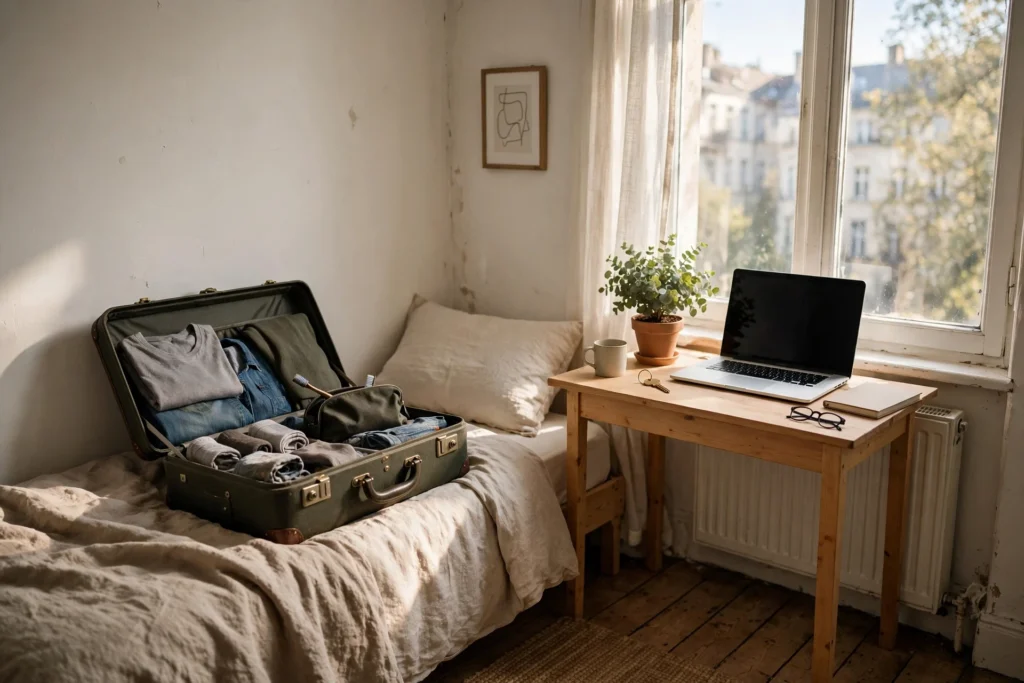
There is no single right moment to stop being a digital nomad, and stopping does not have to mean giving up remote work or travel. The useful question is whether the way you live now still gives you what you wanted from it. This guide covers why people stop, how to tell a rough patch from a lasting change, the options between full-time travel and settling, a three-month test and the practical changes that come with putting down roots.
It is general information, not tax, legal or immigration advice. Rules depend on your citizenship, income and the countries involved, so confirm details with official sources and a qualified professional before you move.
The short version
- Stopping is common and not a failure. Research on how nomads leave the lifestyle points to a fading motivation or a change in family life.
- Separate a bad stretch from a real change. Exhaustion and loneliness often improve with a slower pace. A change that lasts for months across several places is different.
- You have more than two options. Between constant travel and a fixed home sit slow travel, a base with trips, a seasonal base and a home base with a remote job.
- Test before you decide. Spend three months in one place with a budget, a routine and a social plan, then review.
- Settling has its own admin. Tax residency, health cover, housing contracts and banking all change when you stay.
Why people stop being digital nomads
A 2024 paper in the proceedings of the European Conference on Information Systems looked at the whole nomad lifecycle. Researchers at TU Dortmund interviewed 15 digital nomads and described three phases: starting, continuing and stopping. People started for reasons such as a career change, a wish to wander and the chance to work remotely. They kept going while they found the lifestyle fulfilling, had some entrepreneurial drive and took part in the nomad community. The paper reports two routes out: one of the factors that kept them going disappeared, or they settled for family reasons.
Fifteen interviews cannot tell us how many nomads stop or when. It does give a useful frame for your own decision: what first drew you to this life, and which of those reasons still hold?
Common reasons people give, from nomad accounts rather than measured data, include loneliness, exhaustion from constant moves, wanting stability and wanting to be near family. Each has its own guide on this site: making friends while traveling solo, digital nomad burnout and slow travel.
A rough patch or a real change?
Most nomads have weeks when they want to go home. A few questions help separate a bad stretch from something lasting. The table is our own judgment, not research.
| Question | Points to a rough patch | Points to a lasting change |
|---|---|---|
| How long has it lasted? | A few weeks, often after a move or a busy period | Several months, across more than one place |
| Does a change of pace help? | Yes, after a week in one place with a routine | No, it returns wherever you are |
| What do you miss? | Rest, a familiar routine | Specific people, a home, a long-term plan |
| What did you want from nomad life? | Those reasons still matter to you | Those reasons no longer feel important |
| Is anything outside the lifestyle driving it? | No | Yes: a partner, family, a health issue or a career change |
If low mood, sleep problems or hopelessness are part of the picture, speak to a doctor or qualified professional before making a big decision. Our guide to loneliness lists the signs that justify asking for help.
It is not all or nothing
People often picture two options, keep moving or go home. Several in-between arrangements exist, and each trades something different.
| Option | What you keep | What you give up |
|---|---|---|
| Constant travel | Maximum variety and freedom | Routine, deep friendships and rest |
| Slow travel | New places, with time to settle in each | Some variety, and you plan stays around visa limits |
| One base with trips | A home, a community and travel | Constant novelty, and you commit to one place for a lease or visa period |
| Seasonal base | Two or three homes through the year | Simplicity, since you manage two sets of housing and admin |
| Home base with remote work | Family, friends, familiar healthcare and a stable routine | Daily novelty and low cost of living abroad, if that mattered |
Many people find a middle option fits better than either extreme. Our guide to slow travel explains how long to stay in each base, and digital nomad pros and cons sets out the trade-offs of each side.
Test before you decide: a three-month trial base
A trial turns a feeling into evidence. Choose one place where you could imagine living for a year and run it as if you had already chosen it.
- Pick one base. Check that you can stay legally for three months. Our visas guide explains the options.
- Set a monthly budget and track what you actually spend.
- Build a routine with fixed work hours, a regular place to work and weekly exercise.
- Plan your social life around one or two repeating activities and a standing call with people from home.
- Take no new trips for the first month, so you see the place without the novelty of arriving.
At the end, write down answers to three questions: Did my energy improve? Do I want to stay longer? What did I miss about moving?

What changes when you settle
Staying put changes your paperwork as much as your lifestyle. This is general information, and each item depends on your own situation.
| Area | What to check | Where to read more |
|---|---|---|
| Tax residency | A longer stay can make you tax resident in the country, and US citizens keep US filing duties | Digital nomad taxes |
| Legal status | A tourist stay is not a base. You may need a residence permit or a visa that allows a longer stay | Visas explained |
| US home state and mail | If you are leaving the US, your domicile and mail setup matter | Domicile for digital nomads |
| Health cover | Travel insurance is built for short trips. Long stays often need local or international cover | Health insurance guide |
| Housing | Lease length, deposit, break clauses and who pays the utilities | Read the contract before you sign, and ask a local you trust |
| Work | Staying remote, switching employer or going back to an office | Working remotely abroad for your employer and digital nomad jobs |
Frequently asked questions
Do digital nomads ever settle down?
Many do. A 2024 study of 15 nomads found that people stopped when a factor that motivated them faded, or when family reasons led them to settle. We found no reliable figure for how many nomads settle or how long they travel before they do.
How long do most people stay digital nomads?
There is no dependable answer. Some websites quote precise averages without citing data, and we have not repeated them. Surveys of nomads exist, but they describe who responds, not how long people stay.
Can I stay a nomad part-time?
Yes. Some people keep a home base and travel for part of the year, or take a seasonal base. Check the tax and visa position for each country you stay in, since time spent in several places still adds up.
What if I regret stopping?
Stopping is rarely permanent. If you keep remote work, you can travel again later, and a trial base before you commit lowers the risk. Keep your savings, skills and remote income intact so the option stays open.
How do I choose a base?
Start with six checks: whether you can stay legally, whether the cost fits your income, how your working hours overlap with your team, where you would get medical care, how you will meet people and how the weather and air quality behave through the year. Our best countries guide compares options.
Sources
- Hensellek S, Weißwange J, de Groot JM, Oers N. “The Digital Nomad Lifecycle: Intrinsic and Extrinsic Motivations to Start, Maintain, and Abandon Digital Nomadism.” ECIS 2024 Proceedings, Future of Work track. aisel.aisnet.org. Accessed October 2026.
Last reviewed: October 2026. This article is general information, not tax, legal, immigration or medical advice. Rules vary by country and change over time. Confirm details with official government sources and a qualified professional.