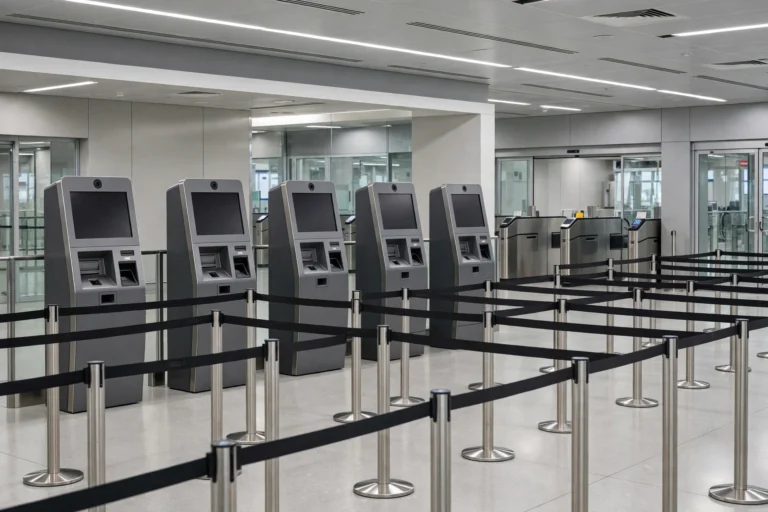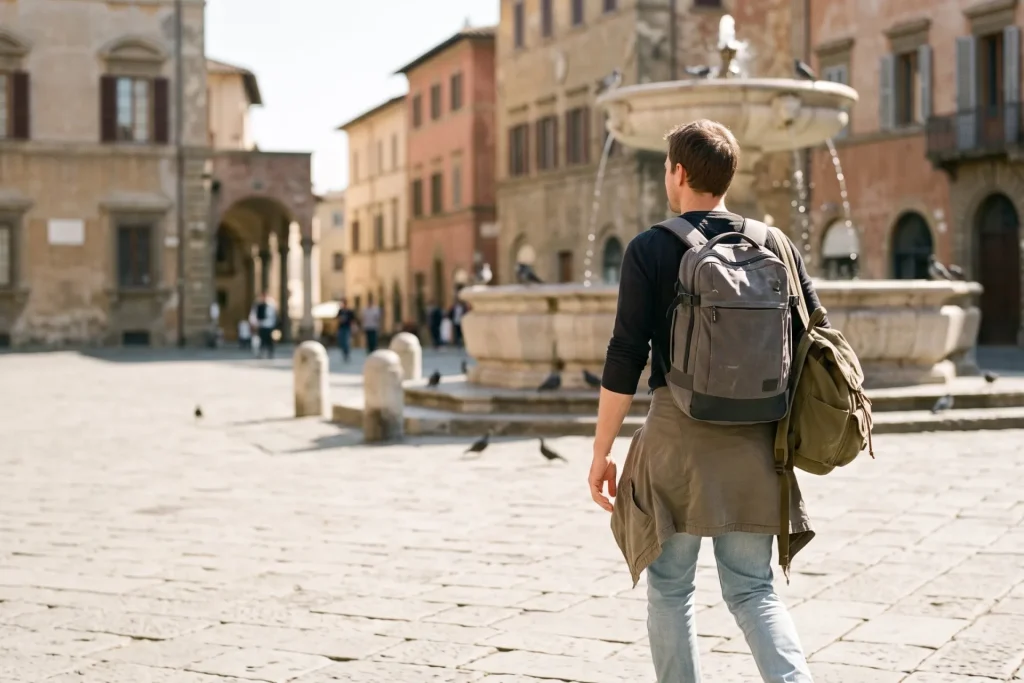
A good digital nomad packing list covers four things: your work setup, your documents and money, a week of clothes that you wash regularly, and a small health kit. Aim to fit everything into one carry-on-size backpack plus a small daypack. You can buy almost anything abroad, so only carry what is hard to replace: your work tech, your documents and your medication. Pack for one week, do laundry weekly, and add extras only when you find you truly need them.
This list is built around remote work, so it starts with the airline and security rules that have changed recently, then covers tech, documents, luggage, clothing and health.
Check these rules before you pack
Power banks are now tightly controlled
Power banks and spare lithium batteries must travel in your carry-on, never in checked luggage. In 2026 the International Civil Aviation Organization introduced new global rules limiting passengers to two power banks and prohibiting recharging them during flights, effective from 27 March 2026. You can read the announcement on the ICAO website. Several airlines go further and ban using power banks in flight altogether, so check your airline’s page for each trip. Airline limits are set in watt-hours rather than mAh, and larger power banks (above 100 Wh) usually need the airline’s approval. If your carry-on is gate-checked, take the power bank out and keep it with you.
Liquids: the 100 ml rule still applies at most airports
New scanners have led some airports to allow containers of up to 2 litres, but this is far from universal. The US still enforces its 3-1-1 rule (containers of 3.4 oz or 100 ml, in one quart bag), and many European airports still apply 100 ml. Which? notes that the destination airport may not have the new scanners either. Pack toiletries in 100 ml containers unless you have checked the rule at every airport on your route, including your return.
Bag size and passport validity
Carry-on size and weight limits differ between airlines, and budget airlines are usually strictest. Choose a bag that fits the tightest airline you plan to use. Many countries also require your passport to be valid for several months beyond your stay, with blank pages. Check each country’s official requirements before you book.
Work kit
| Item | Why you need it | Notes |
|---|---|---|
| Laptop and charger | Your income depends on it | Keep it in your daypack, never checked |
| Laptop stand, keyboard and mouse | Protects your neck and wrists | See our ergonomic travel gear guide |
| Headphones | Calls in noisy cafés and rentals | Bring a wired backup |
| Phone with a way to get data | Backup internet and hotspot | Make sure it is unlocked so you can use local SIMs or an eSIM |
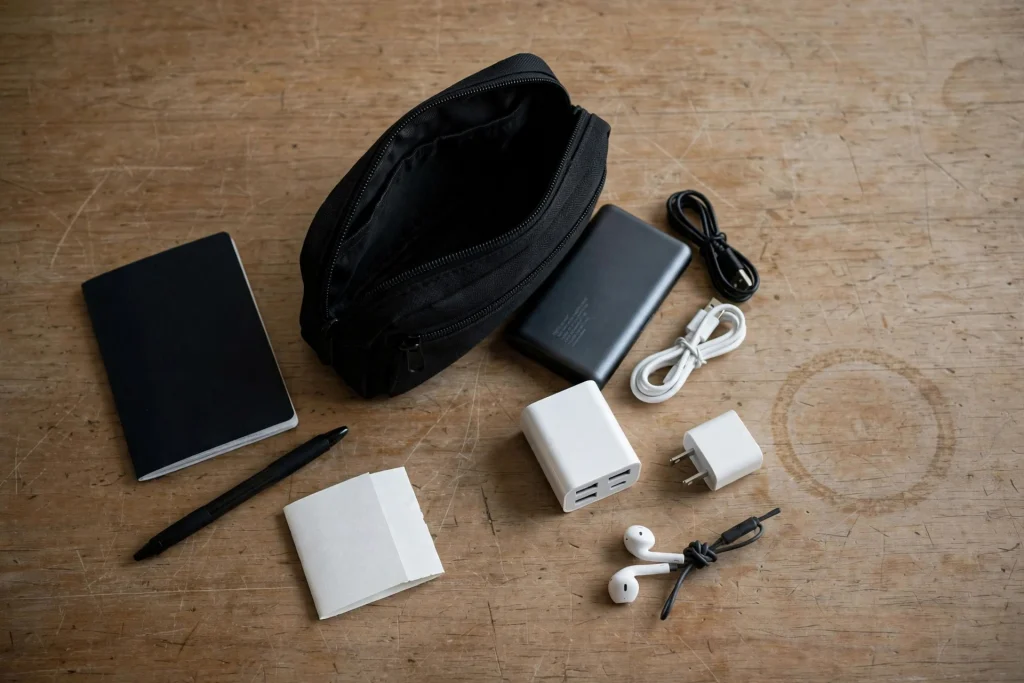
| Power bank | Keeps you working on travel days | Carry-on only, see the rules above |
| Plug adapter and multi-port charger | Charge everything from one socket | Check the input range printed on each charger; many accept 100 to 240 V, so you often need only a plug adapter, not a voltage converter |
| Backup drive or cloud backup | Losing your laptop should not mean losing your work | Back up before every flight |
Always have a second way to get online. A local eSIM or SIM with enough data to tether covers you when apartment Wi-Fi fails during an important call.
Documents and money
- Passport, plus visas or entry approvals for your next destination.
- Copies of everything, stored in encrypted cloud storage and on your phone, and kept separately from the originals.
- Proof of onward travel and accommodation where an airline or border officer may ask for it.
- Travel or health insurance details, including the policy number and the 24-hour emergency contact.
- Two payment cards from different banks, stored in different places, plus a small amount of cash for arrival. See credit cards for travelers and digital nomads and our banking section in how to become a digital nomad.
- Prescriptions with the generic name of each medicine, and a doctor’s letter for anything that may be restricted abroad.
Luggage
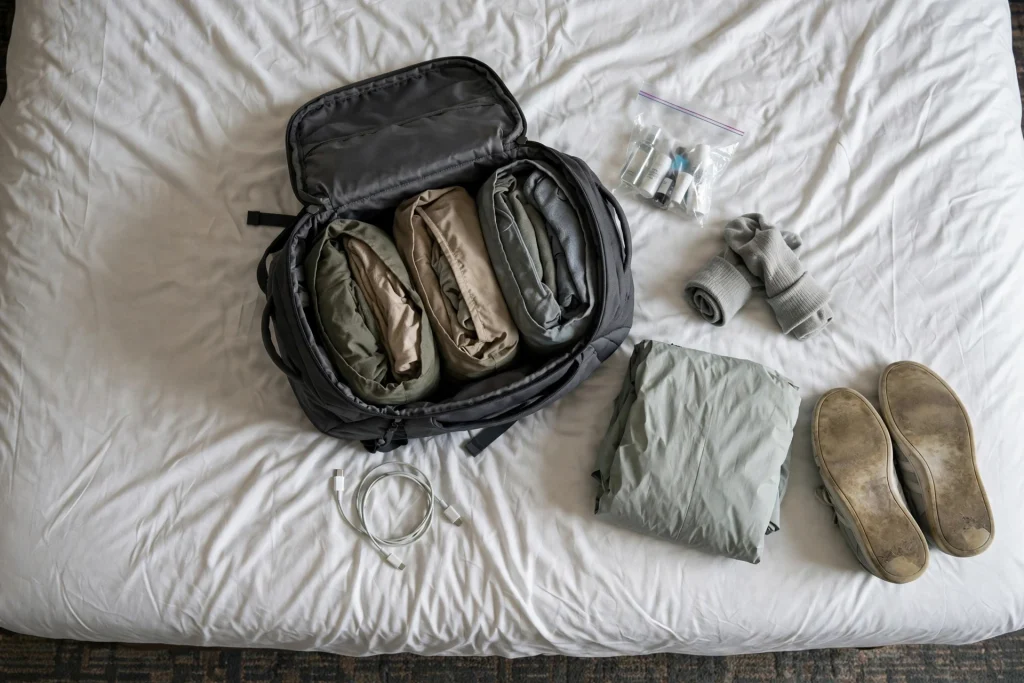
Use one main bag that meets carry-on limits, and a small daypack for your laptop and daily items. A travel backpack is easier than a suitcase on cobbled streets and stairs, while a wheeled bag is better if you rarely walk far with it. Whatever you choose:
- Look for a padded laptop compartment, a clamshell opening that makes packing easy, and good shoulder straps.
- Use packing cubes to keep clothes organized and compressed.
- Carry a small lock for hostels, lockers and rentals.
- Keep valuables in your daypack, which stays with you.
Clothing: one week, then laundry
Pack for about a week and plan to wash regularly, at a laundromat, through a local laundry service or by hand. That keeps your bag small whether you stay three weeks or three months.
- Everyday base: five to seven tops, two or three bottoms, underwear and socks for a week, one warm layer and one light rain jacket.
- One smart outfit for client meetings, embassy visits or a nice dinner.
- Fabrics: quick-drying and breathable in hot climates; layers that pack small in cold ones.
- Shoes: one comfortable pair for walking, sandals or slides, and only add a third pair if your activities need it.
- Buy locally for extreme weather. It is cheaper than carrying a winter coat through the tropics.
Health and toiletries
Keep toiletries small and refill them abroad. Bring your prescription medication in its original labeled packaging, plus a basic first-aid kit: plasters, pain relief, oral rehydration salts, antiseptic and anything your doctor recommends. Hand sanitizer helps with street food, and our guide to eating healthy on a budget while traveling covers water and food safety. Earplugs and an eye mask make a big difference to sleep on flights and in noisy rentals; see how to beat jet lag.
Rules about medicines and supplements differ by country. Read our guide to carrying supplements and medicines across borders before you pack anything unusual.
Small extras that earn their space
- A reusable water bottle, if the water where you are going is safe to drink or you have a way to treat it.
- A light resistance band and a travel mat for workouts, as in our no-gym fitness plan.
- A quick-dry towel and a small daypack for day trips.
- A paper notebook or an e-reader in place of heavy books.
What to leave at home
- “Just in case” clothing you did not wear on your last trip.
- Full-size toiletries, hairdryers and bulky electronics you can buy or borrow abroad.
- Duplicate devices you rarely use.
- Anything you would be upset to lose that is not essential to work or travel.
Slow travel makes light packing easier because you can shop and wash wherever you stay. See our slow travel guide, and for what a lighter bag saves overall, how to travel full-time on a budget. Packing for a first one-month trip? Our workation guide shows how to plan it.
Frequently asked questions
How much should a digital nomad pack?
One carry-on-size backpack plus a small daypack is enough for most people. Pack for about a week and wash clothes regularly rather than packing for the whole trip.
Can I bring a power bank on a plane?
Yes, in your carry-on only, never in checked luggage. Since March 2026 the international rules limit passengers to two power banks and prohibit recharging them during flights, and some airlines ban using them onboard at all. Check your airline’s rules before you fly.
Do I need a universal travel adapter?
You need a plug adapter for the countries you visit. Check the input range printed on your chargers; if it covers 100 to 240 V, you do not need a voltage converter.
Still deciding whether to go? Start with how to become a digital nomad with no experience.
Last reviewed: September 2026. Airline, airport and border rules change often and vary by country; confirm them on official sources before you travel.