Da Nang is a beach city on Vietnam’s central coast that many remote workers choose for its mix of sea, cafés and lower costs than Western cities. The main things to plan around are visa rules that depend on your passport, a storm and flood season that runs for much of the year, road safety if you ride a scooter, and health precautions for a tropical country. This guide covers costs, visas, weather, health, safety and community, with every figure dated and sourced.
It is general information, not legal, tax, medical or safety advice. Costs come from crowdsourced data and move with exchange rates, and visa rules change often. Confirm details with official sources before you go.
Da Nang at a glance
| What to know | |
|---|---|
| Monthly cost for one person (our sum of Numbeo figures, October 2026) | About 20.6 million Vietnamese dong with a one-bedroom outside the centre, or about 25.2 million with one in the centre |
| Visa-free entry | 45 days for citizens of 24 listed countries. The United States, Canada and Australia are not on the list we found |
| E-visa | Up to 90 days with multiple entries, according to UK government advice |
| Storm season | Normally May to November, according to UK government advice |
| Flood and rain season (central Vietnam) | October to December, according to UK government advice |
| Health | Mosquito-borne illness and air pollution are listed risks. Check vaccines well before you travel |
Visas and entry
Visa-free entry. Vietnam grants 45-day visa-free stays to citizens of 24 countries under two Government resolutions. Resolution No. 44 covers Germany, France, Italy, Spain, the United Kingdom, Russia, Japan, South Korea, Denmark, Sweden, Norway and Finland. Resolution No. 229 covers Belgium, Bulgaria, Croatia, the Czech Republic, Hungary, Luxembourg, the Netherlands, Poland, Romania, Slovakia, Slovenia and Switzerland, and it applies from 15 August 2025 to 14 August 2028. The Vietnamese government’s announcement does not name the United States, Canada or Australia. Lists can change, so check the current list for your passport on the Vietnamese embassy or immigration website before you book.
E-visa. The UK government says Vietnam’s e-visa allows a 90-day stay with multiple entries, restricted to the entry and exit points you choose when you apply. Fees and the list of eligible nationalities are published on the official portal, evisa.gov.vn.
Passport. UK advice says your passport must be valid for at least six months after arrival, have at least two blank pages and be undamaged. You must enter and leave on the same passport.
Working. UK advice says that for work or study you should check the required visa or work permit with the Vietnam Immigration Department, and that working illegally or overstaying can lead to an exit block until you pay a fine, deportation and a future entry ban. It does not address remote work on a tourist visa or any nomad visa.
We did not find an official statement about a remote-work or digital nomad visa for Vietnam in the sources we read. Before you plan a long stay, ask the Vietnam Immigration Department or an embassy what applies to your situation.
Tax is separate from your visa. Time spent in Vietnam can create tax duties, and US citizens keep US filing duties. Read digital nomad taxes and check Vietnam’s tax authority or a professional before a long stay. Our visas guide explains how remote-work visas work in general.
What it costs
Numbeo is a crowdsourced database, so treat its numbers as a guide, not a quote. The Da Nang page was last updated on 6 October 2026 and drew on 73 contributors and 531 entries over the past year. Figures are in Vietnamese dong (VND), and exchange rates move, so convert at the current rate.
| Item | Numbeo estimate |
|---|---|
| One-bedroom apartment, city centre | 13,628,674 VND a month |
| One-bedroom apartment, outside the centre | 8,963,063 VND a month |
| One person’s monthly costs, excluding rent | 11,604,317 VND |
| Broadband internet, 60 Mbps or faster | 211,333 VND a month |
| Basic utilities, 85 square metre apartment | 2,000,554 VND a month |
| Monthly public transport pass | 130,000 VND (range 100,000 to 160,000) |
| Gym membership | 650,000 VND a month |
| Meal at an inexpensive restaurant | 60,000 VND (range 30,000 to 130,000) |
Adding rent to monthly costs gives about 20.6 million VND outside the centre and about 25.2 million VND in the centre. That sum is our arithmetic, and it does not include insurance, travel or coworking. Compare listings in person, and see how to travel full-time on a budget for how to think about the main costs.
Storm and flood season
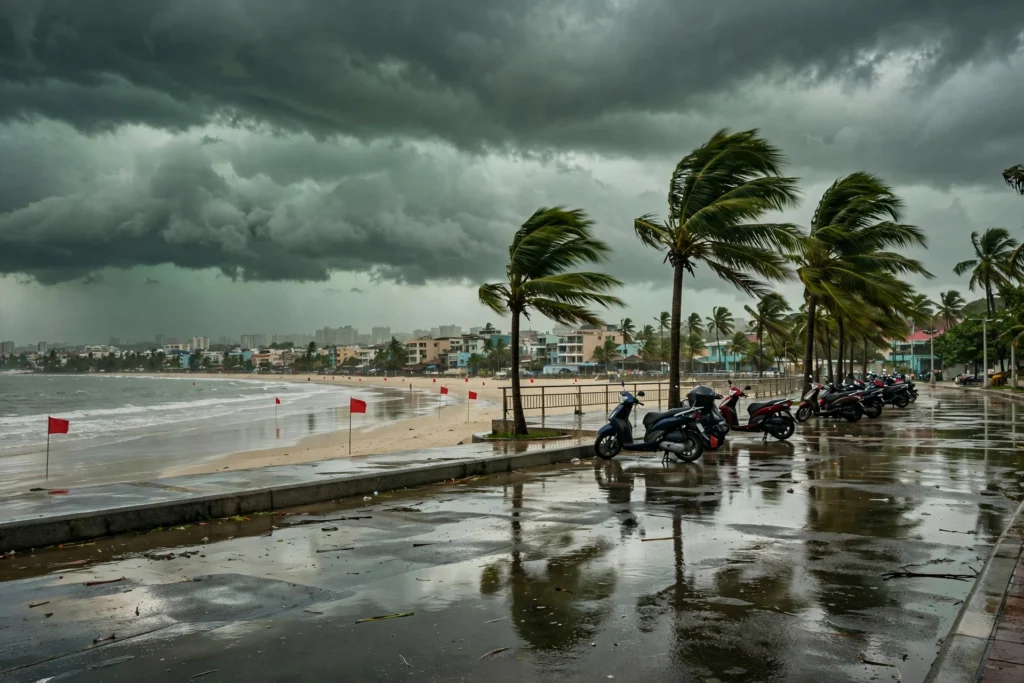
UK government advice says the typhoon season normally runs from May to November, although cyclones can occur at other times, and that tropical storms can cause serious travel disruption. It says the rainy season in central Vietnam, where Da Nang is, runs from October to December, and that seasonal flooding is common in parts of the country. The advice is to monitor forecasts from Vietnam’s National Centre for Hydro-Meteorological Forecasting and the Japan Meteorological Agency, to be ready to change plans at short notice, to keep contact details for your airline, tour operator and insurer, and to follow local authorities, including evacuation orders.
- Book flexible accommodation and flights if you are travelling in the storm months.
- Check what your insurance covers for weather disruption before you buy.
- Keep a backup connection and a charged power bank, since storms can interrupt power and internet.
- Avoid floodwater. The CDC warns about leptospirosis and melioidosis risk from floodwater and muddy soil after heavy rain.
Where to live
Published guides most often mention a few areas. The descriptions below summarise those guides and our own judgment, so visit in person and book a short stay first.
| Area | Commonly described as | Consider |
|---|---|---|
| My An and An Thuong | Close to My Khe beach, with many cafés and restaurants | Popular with visitors, so noise and prices can be higher |
| Son Tra | Quieter, near the peninsula | Fewer services and a longer trip to the centre |
| Khue My | Residential, a short ride from the beach | Fewer international amenities |
| Hai Chau | The city centre, near the river and the main shops | Busier, and further from the beach |
Health and healthcare
The CDC’s guidance for Vietnam, last reviewed on 25 August 2026, recommends hepatitis A and hepatitis B vaccination for unvaccinated travellers, typhoid vaccination for most travellers and confirmation that you are fully vaccinated against measles. It recommends Japanese encephalitis vaccination for long-term residents and frequent or extended travellers, and says rabies vaccination should be decided with a healthcare provider based on your exposure to animals and access to care. It also lists a global dengue travel health notice and advises mosquito bite prevention, safe food and water and frequent handwashing. Speak to a travel health clinic well before you go.
UK government advice warns that medical bills can be expensive, says the British Embassy does not pay them, and recommends insurance that covers existing conditions, air ambulance transport and repatriation. It adds that air pollution is a health risk. Vietnam restricts some medicines, and carrying more than a seven-day supply of certain addictive or psychotropic medicines without proper documentation is illegal, so carry your prescription and a doctor’s letter. Read our health insurance guide for what to check, including motorbike cover.
We have not listed hospitals or clinics because we could not confirm them from official or hospital sources. Ask your insurer which providers it works with, and check hospital websites for English-language services.
Safety and scooters
- Riding a scooter. UK advice says motorbike travel is much riskier than in the UK and that a helmet is legally required for drivers and passengers. UK drivers need both a 1968 international driving permit and their UK licence, and third-party insurance is compulsory. Check the rules for your own licence, rent from a reputable business and make sure your travel insurance covers motorbike use.
- Theft. Petty theft is regular, and motorcycle bag-snatchers operate in crowded and tourist areas. Keep phones and bags away from the roadside.
- Taxis and drinks. Use apps such as Grab or XanhSM, avoid unlicensed taxis and buy your own drinks. Methanol in alcohol has caused deaths and cannot be detected by taste or smell.
- Passports and jobs. Never leave your passport as a deposit for a bike rental or landlord, and never hand it to an employer. Check job offers carefully. Our guide to digital nomad scams covers fraud to avoid.
Community and daily life
Da Nang has a growing international remote-work community and many cafés and coworking spaces, especially near My Khe beach. We do not list venues because prices and opening hours change, so visit a few before you pay for a membership. For mobile data, see eSIM vs local SIM. To meet people, choose activities with a repeating schedule, and read our guides to loneliness and making friends while traveling solo. If your clients are in Europe or North America, check the overlap in our time zone guide.
For comparison with other bases in the region, see Chiang Mai and Bali.
Who Da Nang suits, and who it does not
- A good fit: people who want a beach city with lower costs than Western cities, who have a passport that qualifies for visa-free entry or an e-visa and who can plan around the storm season.
- A poorer fit: people who need a clear long-stay work visa, anyone who is nervous about scooters and traffic, and people who cannot work around weather disruption between October and December.
Frequently asked questions
Do I need a visa for Da Nang?
It depends on your passport. Citizens of 24 listed countries can enter visa-free for 45 days under two government resolutions, and others can apply for an e-visa. The United States, Canada and Australia are not named in the announcement we found, so check the current list for your passport.
How long does the e-visa last?
UK government advice says the e-visa allows a stay of 90 days with multiple entries. Check the official portal, evisa.gov.vn, for fees and eligibility when you apply.
When is typhoon season in Da Nang?
UK government advice says the season normally runs from May to November, although cyclones can occur at other times, and that central Vietnam’s rainy season runs from October to December. Monitor forecasts and follow local authorities.
How much does it cost to live in Da Nang?
Using Numbeo’s crowdsourced figures from October 2026, one person’s monthly costs plus a one-bedroom rent come to about 20.6 million VND outside the centre and about 25.2 million VND in the centre. That excludes insurance, travel and coworking.
Can I rent a scooter legally?
UK government advice says UK drivers need a 1968 international driving permit plus their UK licence, that third-party insurance is compulsory and that helmets are required. Rules depend on your licence, so check them for your own country before you ride.
Sources
- UK Foreign, Commonwealth & Development Office, “Vietnam travel advice”: entry requirements, safety and security, health. Accessed October 2026.
- Vietnam Government news, “Viet Nam waives visas for citizens of 24 countries from mid-August”, 15 August 2025. en.baochinhphu.vn. Accessed October 2026.
- Vietnam National Electronic Visa system. evisa.gov.vn.
- CDC, “Vietnam: Traveler Health Guidance”. wwwnc.cdc.gov. Last reviewed 25 August 2026. Accessed October 2026.
- Numbeo, “Cost of Living in Da Nang”. numbeo.com. Crowdsourced data, updated 6 October 2026. Accessed October 2026.
Last reviewed: October 2026. Visa rules, weather risks, costs and health guidance change. Cost figures are crowdsourced estimates and exchange rates move. This article is general information, not legal, tax, medical or safety advice; confirm details with official sources and local guidance.